Walk into any pharmacy or beauty store, and you’ll notice something interesting.
If a supplement promises:
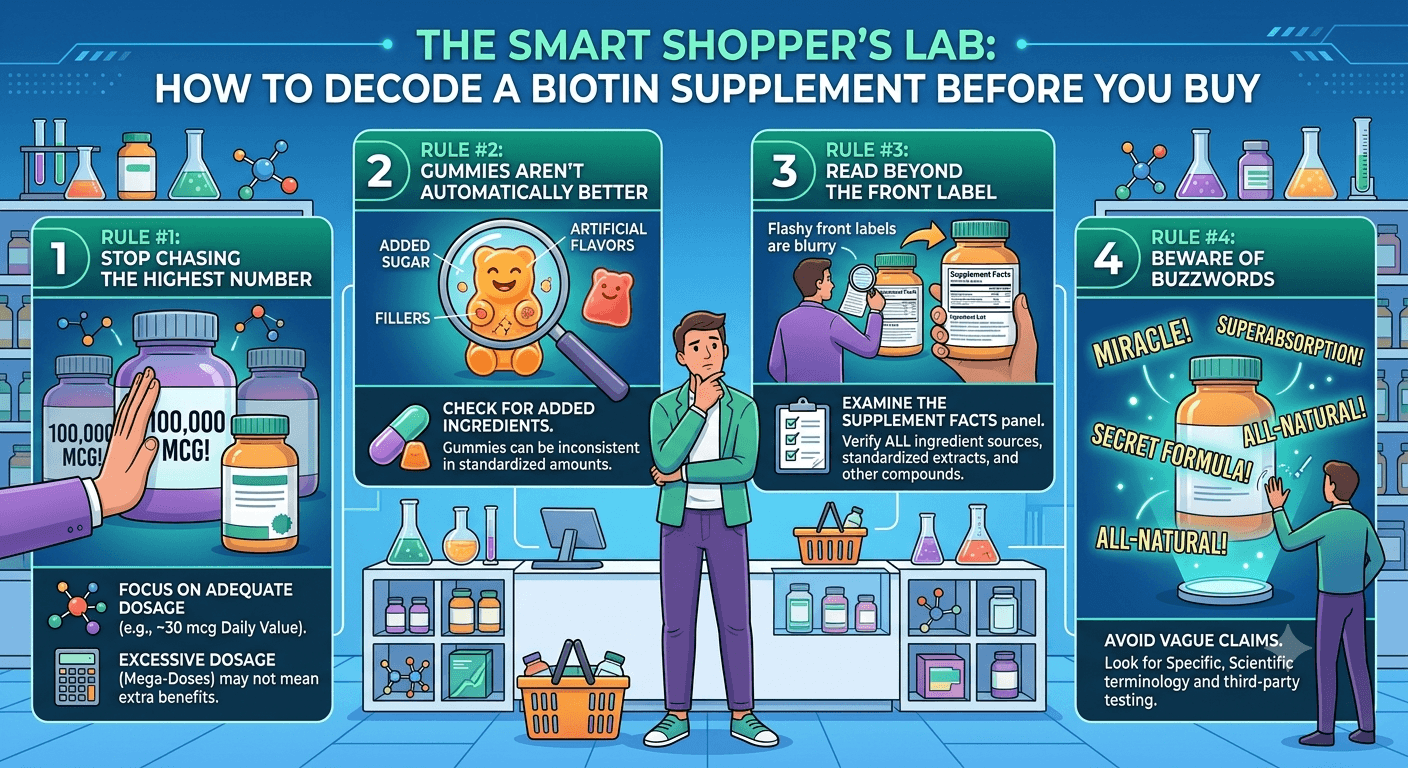
- Longer hair
- Thicker hair
- Stronger nails
- Healthier skin
There’s a good chance Biotin for Hair Growth is listed on the label.
Scroll through social media, and you’ll find thousands of influencers recommending Biotin gummies as the secret behind dramatic hair transformations.
The message seems simple:
Take Biotin. Grow better hair.
If only it were that straightforward. The reality is much more interesting. Biotin is indeed an essential vitamin. Your body needs it.
But that doesn’t automatically mean taking large amounts will give everyone thicker hair or faster hair growth.
In fact, one of the biggest misconceptions in the supplement industry is believing that more vitamins automatically lead to better results.
With Biotin, that’s not necessarily true.
Part 1 – The ‘Biotin for Hair Growth’ Myth Everyone Has Heard
This article isn’t here to convince you to buy Biotin.
It’s here to answer one question honestly:
Does Biotin deserve its reputation as the ultimate beauty vitamin?
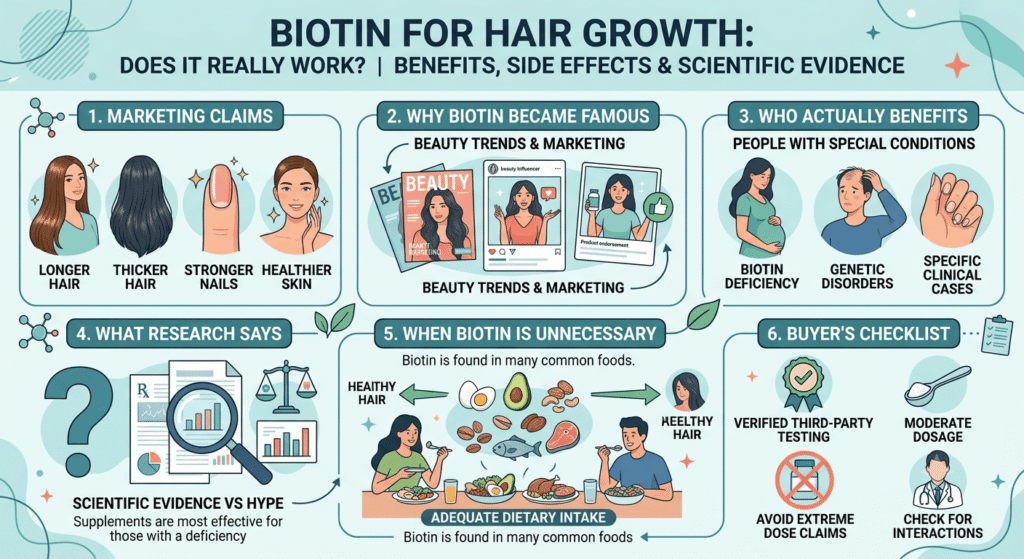
By the end of this guide, you’ll know:
- Why Biotin became famous
- Who is actually likely to benefit
- What research says about hair, skin, and nails
- When Biotin supplements may be unnecessary
- How to choose a quality product if you decide it’s right for you
Let’s start with the vitamin itself.
First, What Exactly Is Biotin?
Biotin is also known as Vitamin B7 or Vitamin H.
It’s one of the eight B-complex vitamins and plays a role in helping the body convert carbohydrates, fats, and proteins into usable energy.
Biotin also contributes to normal functioning of enzymes involved in metabolism.
Because hair, skin, and nails are constantly growing and renewing themselves, researchers became interested in whether Biotin might help support these tissues.
That’s how Biotin earned its reputation as the “beauty vitamin.”
But here’s an important distinction:
Being essential doesn’t mean extra amounts automatically produce extra benefits.
That’s the question science has been trying to answer.
Why Do People Become Deficient?
Unlike some nutrients, true Biotin deficiency is relatively uncommon in healthy people consuming a balanced diet.
However, deficiency can occur in certain situations, including:
- Long-term use of specific medications
- Certain inherited metabolic disorders
- Chronic alcohol misuse
- Pregnancy (where requirements may change)
- Rare conditions affecting nutrient absorption
When deficiency occurs, symptoms may include:
- Hair thinning
- Brittle nails
- Skin rashes
- Fatigue
- Neurological symptoms
This is important because many of the dramatic improvements seen in deficiency cases should not be assumed to occur in people who already have adequate Biotin levels.
Where Do We Naturally Get Biotin?
Many people already consume Biotin through everyday foods.
Good dietary sources include:
- Eggs (well cooked)
- Salmon
- Beef liver
- Almonds
- Sunflower seeds
- Sweet potatoes
- Mushrooms
- Spinach
- Broccoli
Most healthy adults can meet their Biotin needs through a varied diet.
This raises an important question:
If most people already get enough Biotin, why has supplementation become so popular?
The answer lies in marketing—and in a few promising scientific findings that have sometimes been overstated.
We’ll separate those two in the next section.
Why ‘Biotin for Hair Growth’ Became a Billion-Dollar Supplement
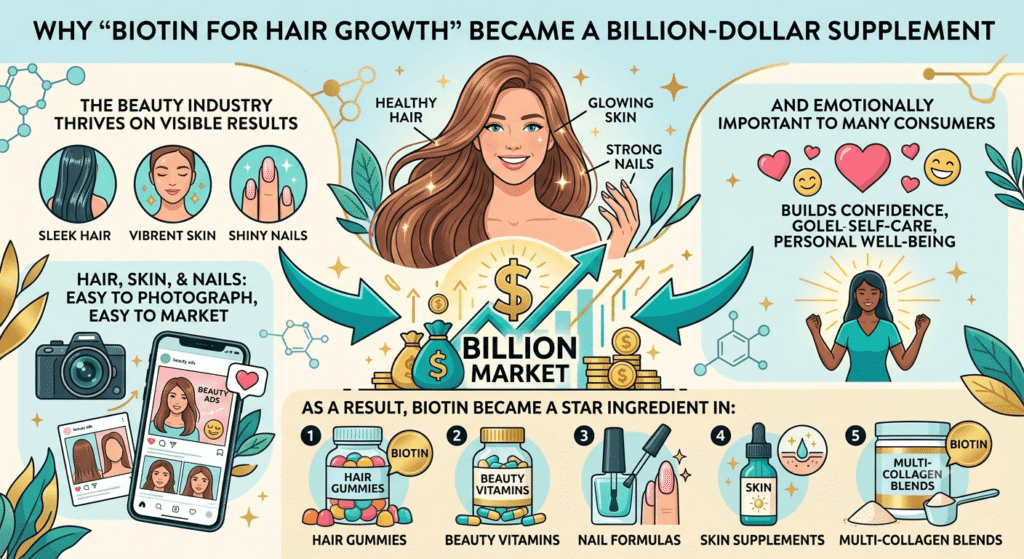 The beauty industry thrives on visible results.
Hair, skin, and nails are easy to photograph, easy to market, and emotionally important to many consumers.
As a result, ‘Biotin for Hair Growth’ became a star ingredient in:
- Hair gummies
- Beauty vitamins
- Nail formulas
- Skin supplements
- Multi-collagen blends
Many products contain thousands of micrograms of Biotin—far more than the daily requirement.
Seeing these high numbers, it’s natural to assume:
Higher dose = Better hair.
But nutrition rarely works that way.
The body only needs a certain amount of Biotin for normal function.
Whether taking much larger amounts provides additional benefits for healthy individuals is exactly what researchers have been investigating.
Before We Dive Into the Science…
Keep these three ideas in mind:
Myth #1
Every hair problem is caused by low Biotin.
Not true.
Hair health is influenced by genetics, hormones, stress, nutrition, age, and medical conditions.
Myth #2
Everyone needs a Biotin supplement.
Not necessarily.
Many healthy adults already consume enough Biotin through food.
Myth #3
More Biotin always means faster hair growth.
Current scientific evidence doesn’t support this as a universal rule.
Part 2: The Evidence Check – Which Biotin Claims Hold Up Under Scientific Scrutiny?
Now that we’ve uncovered why ‘Biotin for Hair Growth’ became one of the world’s best-selling beauty supplements, it’s time to answer the question millions of buyers ask before clicking “Add to Cart.”
Does Biotin actually work—or has clever marketing made it seem more powerful than it really is?
Unlike many beauty supplements, the answer isn’t simply “yes” or “no.”
Biotin has clear, evidence-based uses in certain situations.
However, many of the claims used in advertisements go far beyond what current scientific research supports.
Let’s investigate the biggest claims one by one.
Claim 1: “Biotin Makes Hair Grow Faster“
Verdict
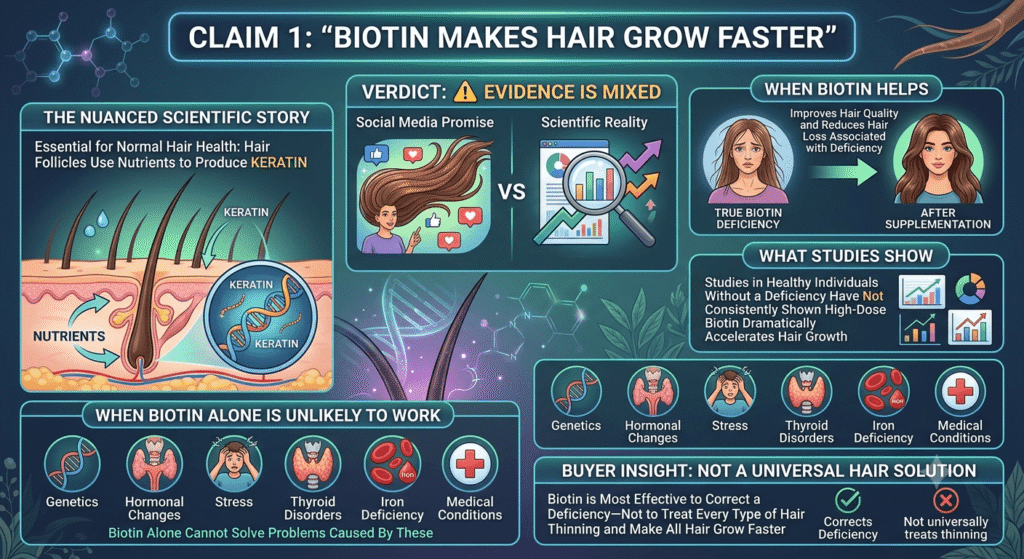
⚠️ Evidence Is Mixed
This is by far the biggest reason people buy Biotin.
Social media often presents Biotin as if it’s a guaranteed solution for hair growth.
Scientific research tells a more nuanced story.
Biotin is essential for normal hair health because hair follicles rely on nutrients to produce keratin, the protein that forms hair strands.
When someone has a true Biotin deficiency, supplementation can improve hair quality and reduce hair loss associated with that deficiency.
However, studies involving healthy individuals without a deficiency have not consistently shown that high-dose Biotin dramatically accelerates hair growth.
What This Means
If your hair loss is caused by:
- Genetics
- Hormonal changes
- Stress
- Thyroid disorders
- Iron deficiency
- Certain medical conditions
Biotin alone is unlikely to solve the problem.
Buyer Insight
Biotin isn’t a universal hair-growth supplement.
It’s most effective when correcting a deficiency—not when treating every type of hair thinning.
Claim 2: “Biotin Gives You Stronger Nails”
Verdict
✅ Supported by Good Evidence
Compared with hair growth, the evidence for brittle nails is more encouraging.
Several small clinical studies have reported improvements in:
- Nail thickness
- Reduced nail splitting
- Less breakage
These improvements were primarily observed in people with fragile or brittle nails.
However, the number of high-quality studies remains relatively small.
What This Means
If brittle nails are your primary concern, Biotin may be worth discussing with your healthcare provider.
For healthy nails that are already strong, additional supplementation may provide little noticeable benefit.
Claim 3: “Biotin Improves Skin”
Verdict
🔬 Research Still Emerging
Beauty supplements frequently advertise Biotin for glowing skin.
Interestingly, the evidence here is much weaker than most advertisements suggest.
People with severe Biotin deficiency may develop skin problems such as rashes or dermatitis, and correcting the deficiency improves those symptoms.
But there is limited evidence that taking high-dose Biotin improves skin appearance in healthy adults who already consume enough Biotin.
What This Means
Healthy skin depends on many factors:
- Hydration
- Sun protection
- Nutrition
- Sleep
- Genetics
- Hormonal balance
No vitamin can replace these foundations.
Claim 4: “More Biotin Means Better Results”
Verdict
❌ Mostly Marketing
Walk into any supplement store and you’ll see products containing:
- 1,000 mcg
- 5,000 mcg
- 10,000 mcg
- Even higher doses
The numbers are impressive.
But bigger isn’t automatically better.
Biotin is a water-soluble vitamin, meaning the body doesn’t store large amounts in the same way it stores fat-soluble vitamins.
Current research hasn’t shown that extremely high doses consistently produce better hair, skin, or nail outcomes in people who already meet their nutritional needs.
What This Means
Don’t judge a supplement by the biggest number on the label.
Quality and appropriate use matter far more than extremely high dosages.
Claim 5: “Biotin Causes Acne”
Verdict
🔬 Research Still Emerging
This topic appears frequently on beauty forums and social media.
Some users report developing acne after starting Biotin supplements.
However, scientific evidence directly linking Biotin supplementation to acne remains limited.
Researchers haven’t established a clear cause-and-effect relationship.
Acne is influenced by numerous factors, including:
- Hormones
- Genetics
- Skincare products
- Diet
- Stress
- Overall health
What This Means
If you notice new skin breakouts after beginning Biotin for Hair Growth, discuss the issue with your healthcare provider rather than assuming Biotin is necessarily responsible.
Claim 6: “Biotin Boosts Energy”
Verdict
⚠️ Evidence Is Mixed
Biotin participates in converting carbohydrates, fats, and proteins into usable energy.
This has led many advertisements to describe it as an energy vitamin.
Here’s the important distinction:
Biotin helps your body produce energy from food.
It doesn’t function like caffeine or other stimulants.
If you’re deficient, correcting that deficiency may improve symptoms related to inadequate nutrient intake.
If you’re already getting enough Biotin, supplementation is unlikely to make you feel significantly more energetic.
Claim 7: “Biotin Is Safe for Everyone”
Verdict
⚠️ Evidence Is Mixed
Biotin is generally well tolerated when used appropriately.
However, there’s an important safety issue that many advertisements never mention.
High-dose Biotin can interfere with certain laboratory blood tests, potentially affecting results for tests related to thyroid function, heart health, hormones, and other medical conditions.
This doesn’t mean Biotin is unsafe.
It simply means your healthcare provider should know if you’re taking high-dose Biotin before laboratory testing.
Buyer Insight
Always tell your doctor or laboratory staff about any Biotin supplements you’re taking before having blood work performed.
The Biotin Truth Scorecard
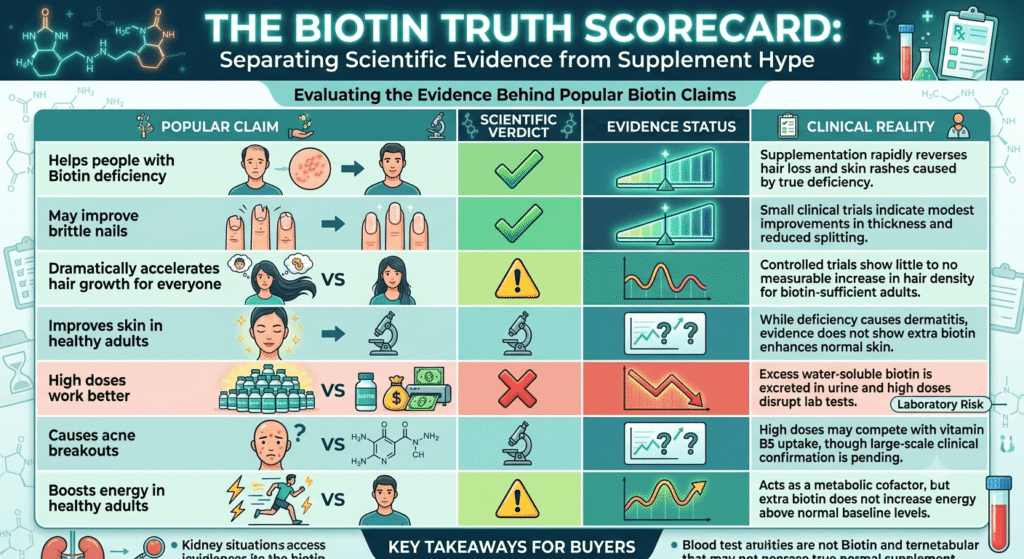
| Popular Claim | Verdict |
| Helps people with Biotin deficiency | ✅ Supported by Good Evidence |
| May improve brittle nails | ✅ Supported by Good Evidence |
| Dramatically accelerates hair growth for everyone | ⚠️ Evidence Is Mixed |
| Improves skin in healthy adults | 🔬 Research Still Emerging |
| High doses work better | ❌ Mostly Marketing |
| Causes acne | 🔬 Research Still Emerging |
| Boosts energy in healthy adults | ⚠️ Evidence Is Mixed |
One thing becomes clear after reviewing the research:
Biotin for Hair Growth isn’t overrated—but it’s often overpromoted.
Its greatest strength is correcting deficiency and supporting normal biological functions.
Its biggest weakness is the unrealistic expectations created by advertising.
The Most Important Question Buyers Should Ask
Instead of asking:
“Does Biotin work?”
A better question is:
“Will Biotin solve the specific reason I’m experiencing hair or nail problems?”
That’s because not every beauty concern is caused by inadequate Biotin.
Hair thinning, for example, may result from:
- Iron deficiency
- Low protein intake
- Thyroid disorders
- Hormonal changes
- Chronic stress
- Genetics
- Aging
- Certain medications
Taking Biotin for Hair Growth without identifying the underlying cause may lead to disappointment—not because Biotin is ineffective, but because it wasn’t addressing the real issue.
A Smarter Way to Think About Beauty Supplements
One of the biggest mistakes consumers make is assuming every beauty concern requires a beauty supplement.
In reality:
- Collagen Peptides have stronger evidence for supporting skin hydration and elasticity.
- Vitamin C plays a crucial role in natural collagen production.
- Adequate protein intake provides the building blocks for healthy hair and nails.
- Biotin is most valuable when dietary intake is inadequate or deficiency exists.
The best supplement depends on your specific concern, not the latest social media trend.
Part 3: The Smart Shopper’s Lab – How to Decode a Biotin Supplement Before You Buy
 Imagine you’re standing in the supplement aisle.
On one shelf, you see:
- Biotin 5,000 mcg
- Biotin 10,000 mcg
- Hair, Skin & Nails Formula
- Extra Strength Beauty Gummies
- Maximum Potency Biotin
- Professional Salon Formula
Every package claims it’s the best.
The prices range from inexpensive tablets to premium gummies costing three or four times more.
Here’s the surprising part:
Many of these products contain the same active ingredient.
So why such a huge difference in price?
The answer lies in marketing, formulation, convenience, and brand positioning—not necessarily effectiveness.
Let’s learn how to separate real value from clever advertising.
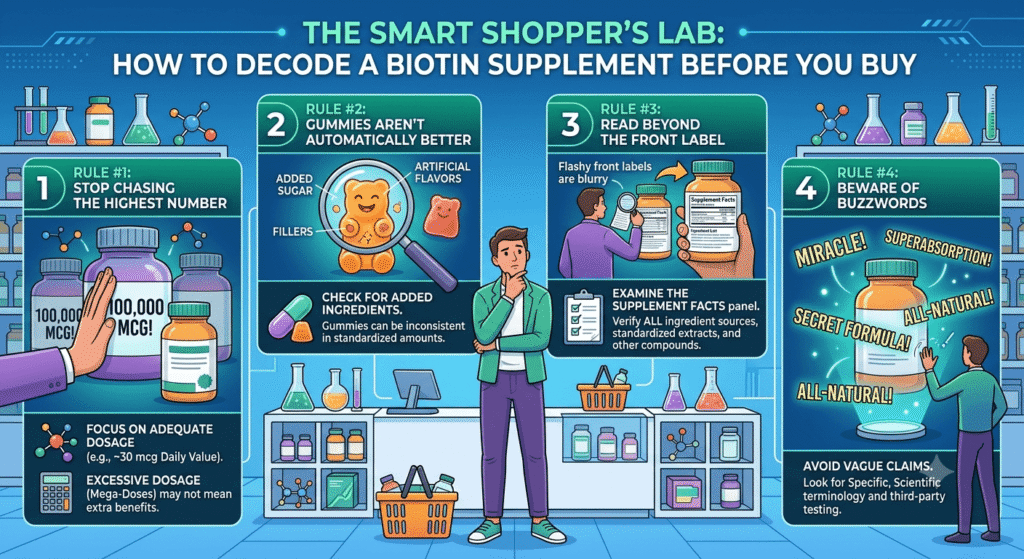
Rule #1: Stop Chasing the Highest Number
This is probably the biggest mistake first-time buyers make.
Many shoppers assume:
10,000 mcg must be twice as effective as 5,000 mcg.
It sounds logical.
Unfortunately, human biology doesn’t work that way.
Biotin for Hair Growth is required only in small amounts for normal body functions.
Current scientific evidence does not consistently show that megadoses produce better hair growth in healthy individuals who are not deficient.
Smart Shopping Tip
Don’t let dosage alone determine your purchase.
Instead, ask:
- Is this dose appropriate for my needs?
- Has my healthcare provider recommended supplementation?
- Am I buying based on evidence or marketing?
Rule #2: Gummies Aren’t Automatically Better
Beauty gummies have exploded in popularity.
They’re colorful, taste good, and are heavily promoted by influencers.
But are they nutritionally superior?
Usually, no.
Gummies
Advantages
- Pleasant taste
- Easy to remember
- Good for people who dislike swallowing pills
Potential Drawbacks
- May contain added sugars
- Artificial colors
- Flavorings
- Lower ingredient concentration in some products
- Often cost more per serving
Capsules or Tablets
Advantages
- Usually contain fewer unnecessary ingredients
- Often more economical
- Easier to compare ingredient amounts
Potential Drawbacks
- Less appealing for people who dislike pills
Smart Shopping Tip
Choose the format you’ll actually take consistently—not the one with the flashiest packaging.
Rule #3: Read Beyond the Front Label
The front of the bottle is designed to sell.
The Supplement Facts panel is designed to inform.
Before buying, check:
Active Ingredient
Does the label clearly state the amount of Biotin?
Transparency matters.
Additional Ingredients
Some beauty formulas include:
- Zinc
- Vitamin C
- Selenium
- Collagen
- Keratin
- Hyaluronic Acid
These ingredients aren’t automatically beneficial simply because they’re included.
Ask yourself:
Do I actually need them?
Sometimes you’re paying for a long ingredient list rather than meaningful value.
Added Sugars
Particularly with gummies, check whether you’re consuming unnecessary added sugar every day.
For a supplement intended for long-term use, simpler formulations are often preferable.
Rule #4: Beware of Buzzwords
The beauty supplement industry loves impressive language.
Let’s decode a few common examples.
“Maximum Strength”
Maximum compared to what?
There’s no universal definition.
It usually refers to a higher Biotin dose—not necessarily better results.
“Professional Formula”
Professional endorsement isn’t guaranteed simply because the label says so.
Look for evidence, not adjectives.
“Beauty Blend”
Sounds impressive.
But beauty blends often combine many ingredients in small amounts without clear evidence that the combination performs better than individual nutrients.
“Clinically Proven”
This phrase deserves careful scrutiny.
Ask:
- Was the finished product studied?
- Or was research conducted only on one ingredient?
- Are the study details publicly available?
Specific evidence is more meaningful than broad marketing statements.
Should You Buy Biotin Alone or a Hair, Skin & Nails Formula?
This is one of the most common purchasing decisions.
Standalone Biotin
Best suited for people who specifically want Biotin and prefer a simple ingredient list.
Advantages:
- Easy to evaluate
- Usually less expensive
- Lower risk of overlapping nutrients
Hair, Skin & Nails Formulas
Typically combine Biotin with vitamins and minerals such as:
- Vitamin C
- Vitamin E
- Zinc
- Selenium
Some also include collagen or botanical extracts.
Advantages:
- Convenient if recommended by a healthcare professional.
- Multiple nutrients in one product.
Potential downside:
More ingredients don’t automatically mean better outcomes.
If your diet already provides sufficient nutrients, additional ingredients may offer little extra benefit.
Can Food Be a Better Investment?
Before buying a supplement, ask yourself a simple question:
Am I getting enough Biotin for Hair Growth from my diet?
Many nutritious foods naturally contain Biotin.
Examples include:
| Food | Natural Source of Biotin |
| Eggs (cooked) | Excellent source |
| Salmon | Rich source |
| Almonds | Good source |
| Sunflower seeds | Good source |
| Sweet potatoes | Moderate source |
| Mushrooms | Moderate source |
| Spinach | Contains Biotin |
| Broccoli | Contains Biotin |
For many healthy adults eating a balanced diet, these foods provide sufficient Biotin without supplementation.
Supplements are designed to complement a healthy diet—not replace it.
Five Questions Every Buyer Should Ask
Before purchasing any Biotin supplement, pause for a minute and ask:
- Why am I taking Biotin?
Is it because of:
- A diagnosed deficiency?
- Brittle nails?
- Hair concerns?
- Social media recommendations?
Understanding your goal helps you make a better decision.
- Have I identified the real cause?
Hair thinning can result from:
- Iron deficiency
- Hormonal changes
- Stress
- Thyroid disorders
- Genetics
- Protein deficiency
A supplement ‘Biotin for Hair Growth’ may not address the underlying cause.
- Am I paying for branding?
Expensive packaging doesn’t always reflect superior quality.
Compare:
- Ingredient list
- Manufacturing standards
- Third-party testing
- Price per serving
- Is this product transparent?
Choose brands that clearly disclose:
- Ingredient amounts
- Serving size
- Manufacturing information
- All inactive ingredients
Transparency is a sign of quality.
- Would I still buy this if influencer marketing disappeared?
This simple question helps separate genuine need from impulse buying.
The best supplement decisions are made using evidence—not trends.
A Consumer Checklist Before Clicking “Buy”
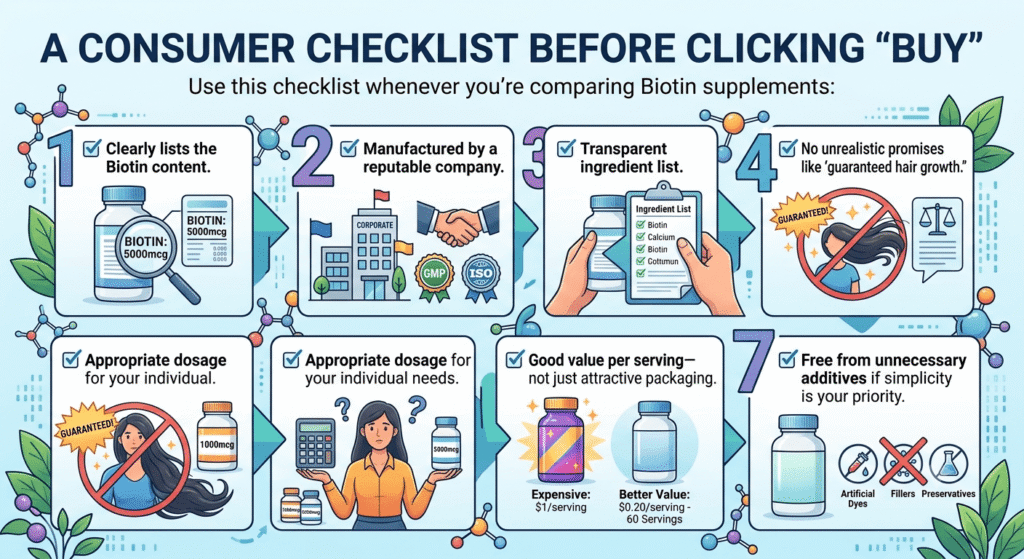
Use this checklist whenever you’re comparing Biotin supplements:
✔ Clearly lists the Biotin content.
✔ Manufactured by a reputable company.
✔ Transparent ingredient list.
✔ No unrealistic promises like “guaranteed hair growth.”
✔ Appropriate dosage for your individual needs.
✔ Good value per serving—not just attractive packaging.
✔ Free from unnecessary additives if simplicity is your priority.
A quality supplement doesn’t need flashy claims to earn your trust.
The Biggest Buying Mistake
Many people spend hours comparing brands…
…without ever asking whether Biotin for Hair Growth is the right supplement for their specific concern.
If your hair thinning is caused by low iron, chronic stress, thyroid disease, or hormonal changes, switching from one ‘Biotin for hair growth’ brand to another probably won’t solve the issue.
Choosing the right supplement is more important than choosing the most expensive supplement.
That’s the difference between shopping like a consumer and shopping like an informed buyer.
Part 4: The Final Answer – Should Biotin Be Part of Your Beauty Routine?
After reading this guide, you may have noticed something surprising.
Biotin isn’t a “bad” supplement.
It also isn’t the miracle beauty vitamin that many advertisements make it out to be.
The truth sits somewhere in the middle.
Biotin for Hair Growth has an important biological role, and for people who genuinely need it, supplementation can be beneficial.
However, for many healthy adults who already consume adequate amounts through food, taking increasingly higher doses is unlikely to produce dramatic improvements in hair, skin, or nails.
So how do you decide whether Biotin is worth buying?
Let’s make that decision easier.
A Simple Beauty Decision Tree
Instead of asking:
“Should everyone take Biotin?”
Ask yourself these questions.
Question 1
Have you been diagnosed with a Biotin deficiency?
Yes
→ Biotin supplementation may be beneficial under the guidance of your healthcare professional.
No
→ Continue to Question 2.
Question 2
Are you experiencing unexplained hair loss?
Before purchasing supplements, consider whether the cause could be related to:
- Iron deficiency
- Thyroid disorders
- Hormonal changes
- Stress
- Genetics
- Certain medications
- Nutritional deficiencies
If the underlying cause isn’t Biotin for Hair Growth deficiency, supplementation alone may not solve the problem.
Question 3
Are brittle nails your biggest concern?
Among the common beauty claims, this is one area where Biotin has reasonably encouraging research.
If brittle nails are affecting you, Biotin may be worth discussing with a healthcare provider.
Question 4
Are you buying Biotin for Hair Growth because everyone on social media recommends it?
If that’s your main reason…
Pause.
Supplements should solve a problem—not simply follow a trend.
Who May Benefit Most?
Biotin supplementation may be appropriate for:
- Individuals with medically confirmed Biotin deficiency.
- People at increased risk of deficiency due to certain medical conditions or medications.
- Adults experiencing brittle nails who have discussed supplementation with a healthcare professional.
- Individuals advised by their doctor or dietitian to increase Biotin intake.
The key point is that Biotin is most useful when there’s a genuine nutritional need.
Who May Not Need Biotin Supplements?
Many healthy adults already obtain sufficient Biotin from foods such as eggs, nuts, seeds, fish, mushrooms, and vegetables.
If you:
- Eat a varied diet,
- Have no signs of deficiency,
- Have healthy hair and nails,
- And have not been advised to supplement,
then adding a high-dose Biotin product may provide little additional benefit.
Sometimes the best wellness decision is not buying another supplement.
Possible Side Effects and Safety Considerations
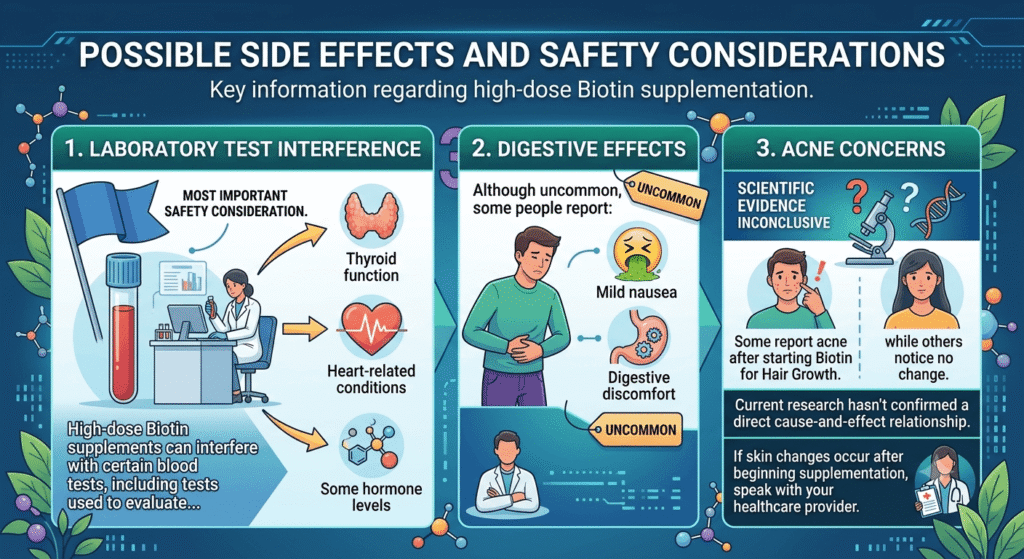
Biotin is generally well tolerated.
However, there are several practical points every consumer should know.
Laboratory Test Interference
This is the most important safety consideration.
High-dose Biotin supplements can interfere with certain blood tests, including tests used to evaluate:
- Thyroid function
- Heart-related conditions
- Some hormone levels
Always tell your doctor or the laboratory staff if you’re taking Biotin before having blood work performed.
Digestive Effects
Although uncommon, some people report:
- Mild nausea
- Digestive discomfort
These effects are usually temporary.
Acne Concerns
Scientific evidence remains inconclusive.
Some people report acne after starting Biotin for Hair Growth, while others notice no change.
Current research hasn’t confirmed a direct cause-and-effect relationship.
If skin changes occur after beginning supplementation, speak with your healthcare provider.
Biotin vs. Collagen: Which One Should You Choose?
This is one of the most frequently searched beauty supplement comparisons.
Here’s a simple way to think about it.
| If Your Primary Goal Is… | Better Choice to Explore |
| Healthy hair in people with Biotin deficiency | Biotin for Hair Growth |
| Skin hydration and elasticity | Collagen Peptides |
| Brittle nails | Biotin |
| Healthy aging of the skin | Collagen Peptides |
| Joint support | Collagen Peptides |
| Overall beauty nutrition | Depends on your individual needs and diet |
Rather than asking:
“Which supplement is better?”
Ask:
“Which supplement addresses my specific concern?”
That’s the smarter question.
Frequently Asked Questions
Q1. How long does ‘Biotin for Hair Growth’ take to work?
When Biotin supplementation is beneficial, noticeable changes—particularly in nails—may take several weeks or even months.
Hair growth is naturally slow, so patience and realistic expectations are important.
Q2. Can I take ‘Biotin for Hair Growth’ every day?
Many Biotin supplements are intended for daily use.
Always follow the dosage instructions on the product label or those provided by your healthcare professional.
Q3. Can I get enough Biotin from food?
For many healthy adults, yes.
Foods naturally rich in Biotin include:
- Cooked eggs
- Salmon
- Almonds
- Sunflower seeds
- Mushrooms
- Sweet potatoes
- Spinach
- Broccoli
A balanced diet remains the best long-term strategy for meeting nutritional needs.
Q4. Should men take Biotin for Hair Growth?
Biotin is an essential vitamin for both men and women.
However, evidence does not show that supplementation promotes hair growth in everyone, regardless of gender.
The benefit depends more on nutritional status than sex.
How We Review Beauty Supplements
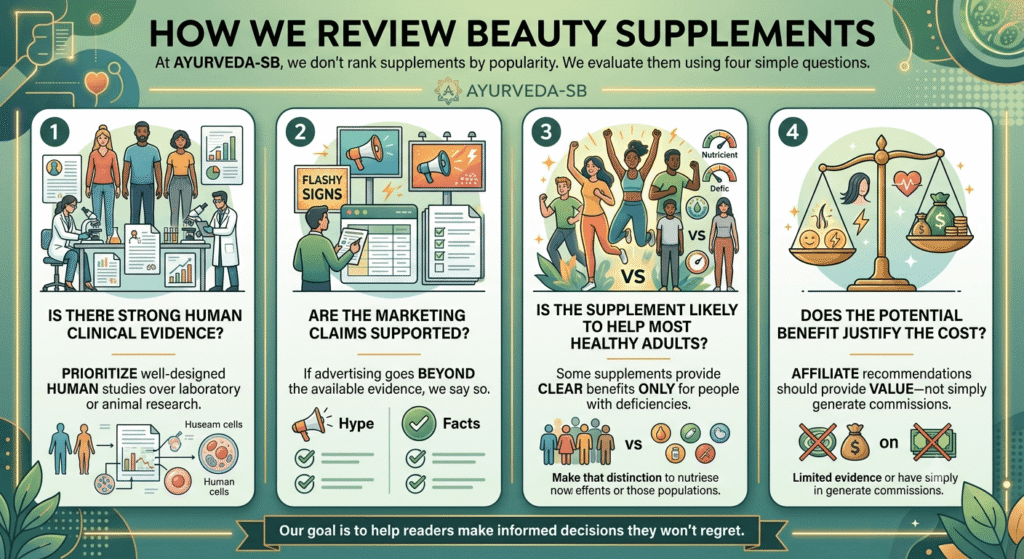
At AYURVEDA-SB, we don’t rank supplements by popularity.
We evaluate them using four simple questions.
- Is there strong human clinical evidence?
We prioritize well-designed human studies over laboratory or animal research.
- Are the marketing claims supported?
If advertising goes beyond the available evidence, we say so.
- Is the supplement likely to help most healthy adults?
Some supplements provide clear benefits only for people with deficiencies.
We make that distinction throughout every guide.
- Does the potential benefit justify the cost?
Affiliate recommendations should provide value—not simply generate commissions.
If a supplement has limited evidence for routine use, we’ll tell you.
Our goal is to help readers make informed decisions they won’t regret.
Final Verdict: Is Biotin for Hair Growth Worth Buying?
Biotin has earned its place in nutrition because it’s an essential vitamin, not because it’s a miracle beauty ingredient.
If you have a confirmed deficiency or specific conditions where supplementation is appropriate, Biotin can play an important role in restoring normal body function.
For healthy adults who already meet their nutritional needs, the evidence is less convincing.
Current research does not support the idea that high-dose Biotin consistently produces faster hair growth, dramatically better skin, or extraordinary beauty results in everyone.
That doesn’t mean Biotin for Hair Growth is ineffective.
It means it’s often marketed far beyond what the science supports.
The smartest approach isn’t asking:
“What’s the strongest Biotin supplement?”
It’s asking:
“Do I actually need Biotin?”
When you answer that question honestly, you’re far more likely to spend your money wisely.